

After years of procrastinating, I finally made the switch to a more secure and privacy-friendly email provider this weekend. And, as is usually the case when finally completing a task I’ve been putting off, it was much easier than I imagined.
A small moment of effort for constant peace of mind.
What is Proton
If you’re not familiar, Proton is a privacy-first email provider, offering end-to-end encryption for your mail. That means the content of your mail stays private between you and the sender or receiver. Just like snail mail.
On top of that, they offer a suite of security tools and privacy-friendly alternatives to popular services, such as a Calendar app, VPN, an online Drive with a spreadsheet and document editor, an authenticator app, and a password manager.
They’re owned by a non-profit foundation, which ensures the services stay aligned with their users’ interests. And they’re based in Switzerland because of the country’s strong privacy laws (and threatened to leave when it considered amending those laws).
In short, they’re a defiant node in a web of enshittification, even providing grants to organisations that defend people’s freedoms.
Degoogling
I guess you could call me a Google power user.
I signed up for Gmail in 2004, when it was still invite-only. I use Google Calendar, Drive, Maps, Photos, Translate, Authenticator, Chrome, and YouTube.
Google might know me better than any of my friends or family.
Google has historically scanned email content directly to target ads as an explicit part of its business model. They claim they no longer do this for advertising.
But my email is still scanned and processed at scale: for spam filtering, search indexing, “smart features”, metadata extraction, and behavioural modelling across Google’s ecosystem. That means my most private communications are continuously parsed and transformed into derivative data I do not control.
Google knows I went to a gym I had never been to before on Tuesday, before returning to that neighbourhood the next day to visit a shop. From my calendar app and my email, Google knows I had an appointment for an eye test at that shop.
It has this data for every day of my life. For decades.
In Google Drive and Photos, Google’s data extraction and profiling systems have access to even more private information.
I’ve long felt uncomfortable with this, but the convenience of Google’s product suite made me reluctant to switch.
If only I had known how easy deGoogling would be.
Why now
Three reasons for finally pulling the trigger: personal momentum, geopolitics, and AI.
AI & ‘vibe hacking’
You may have heard of ‘vibe coding‘, which means programming using text prompts in AI tools like ChatGPT, Claude, or Lovable.
AI allows people with limited technical skills to accomplish outcomes in hours that would have taken months or years. And even for technically skilled people, it allows them to automate things and achieve more in less time.
Unfortunately, that extends to scamming, phishing, and hacking. Meaning this is now easier to execute at a greater scale.
Secondly, I don’t trust that my data won’t somehow be used as training data for large language models when it’s in Google’s hands.
There are opt-outs, but they are limited and don’t include metadata, aggregated data, or engagement patterns, etc. It’s also easy to miss an opt-out you don’t know exists. Or you might assume an opt-out covers all of a corporation’s services, but only extends to their mail client, for example.
If you continue using these services, or even just have a dormant account there, make sure to opt out of AI scraping.
But deleting is better.
After Musk bought Twitter, I deleted all my tweets and went inactive. Twitter had been incredibly important to my career. But I could not justify contributing to Musk’s X. Then, when he announced Grok, I logged back in to permanently delete my account, so xAI’s child sexual abuse material-spawning MechaHitler could not be trained with any remaining metadata, nor would the site ever come up if someone Googled my name.
The uneasy feeling I’ve always had about my privacy has been exacerbated by the AI race. These companies are willing to take huge legal risks because they can earmark part of the billions they’re raising to cover lawsuits and settlements. Meanwhile, the US government seems to tolerate these practices as long as the tech billionaire lackeys keep funding the Trump administration’s coffers for the sake of ‘winning’ said AI race.
Geopolitics
I am incredibly uncomfortable with my data being in the hands of US corporations. This discomfort was bearable and a tradeoff I was willing to make for a long time.
But no longer.
Where it’s reasonably convenient, I want my data encrypted and stored in Europe. You’re more secure with European companies because, unfortunately, the EU, for diplomatic reasons, is reluctant to act swiftly against US companies.
A good example of the EU’s hesitance to act is the current Grok / xAI scandal, in which Musk’s edgelord chatbot took photos of women and minors and undressed them, posting them publicly on X. If any of us were to do that, or to create a system allowing anyone in the world to do that, we’d be in a jail cell tonight.
Meanwhile, X and Grok remain available in EU app stores, and no arrests have been made.
Why? Well, Musk and Trump are buddies again. Money talks.
Personal momentum
It’s been incredibly cold and icy in Berlin these past weeks, so it’s a nice time to stay in and to do some digital cleaning.
A few years ago, I set up a personal homepage by linking a Notion page to a custom domain using Super Publishing. This setup cost me about €200 per year and limited me to Notion’s customisation options.
I decided to vibe code a simple one-page version myself. It took a few hours to get everything right and make adjustments, but now I have a site I control myself completely at marginal cost. Check it out.
I’ve also cut ties with streaming services and have been organising my owned music collection (read more here).
So when the impulse to complete my switch to Proton came, I opened my laptop and locked in.
Why switching to Proton was easier than I expected
I imagined this would take weeks.
I have email forwarders set up; my Gmail collects emails from external inboxes via POP3/IMAP, and I have dozens of accounts set up via Google’s single-sign-on (if not hundreds).
This was fuel for my procrastination.
A wall so solid it would only crack under the US literally sliding into oligarchical fascism.
But Proton’s “Easy Switch” made it... well... easy.
With a few clicks, you ensure that all messages landing in your Gmail account now land in your Proton account. A few more clicks and your entire email history finds its way over to Proton’s more secure platform.
Registering and completing these steps can be done in just a few minutes.
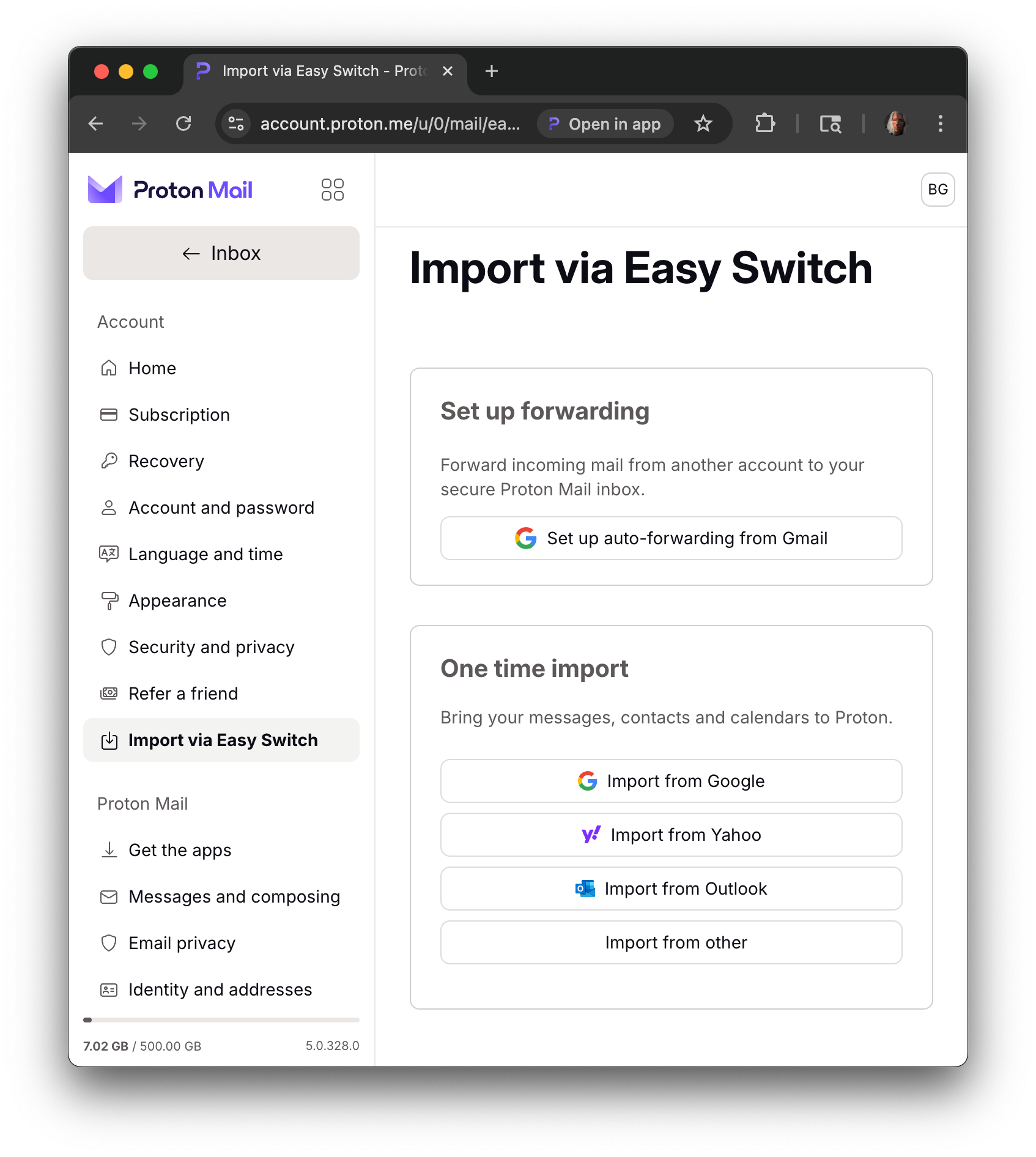
That’s your starting point. Voilà.
Now, when people or services email me on my Gmail address, I can access it and reply from my Proton inbox.
I then set up my custom domains (this is optional, btw), which required some DNS configuration. I had been using custom domains for a while, as a strategy to link things to a domain that I control (as opposed to @gmail.com, which is controlled by Google) in case I ever wanted to do a migration like this.
I had this custom domain running via my Gmail, but now I could just reassign that and have everything addressed to that domain bypass Google and go to Proton directly.
Now all that email is private.
No longer scanned by Google’s algorithms.
From here
My to-do list from here is a bit of a project, but the most important part is done: I’m untethered from Google.
I’ve started using Proton Drive instead of Google Drive, BUT I still need to migrate a lot over. I’m actually writing this post in their text editor, and frankly, so far, I prefer it to Google Docs.
Sidenote: the first time I opened Proton Drive, they gave me 10 minutes to upload data for free, which I assume means it would fall outside their data allowance. I wasn’t quite ready for this, so make sure you have something ready to upload when you first use Drive.Proton Calendar has been easy to use, but unfortunately, for privacy reasons, it doesn’t support scheduling app integrations like Calendly, nor does it have a native version like Google Calendar’s meeting slots. I’ll need to figure something out here.
They have a service called SimpleLogin that creates email aliases directly from their password manager, allowing you to create unique logins for various services (in general, it’s a great security practice to have as few things as possible tied to a single email address). I was already signing up for many services using email addresses I don’t use for correspondence, and only I know.
You can even do this with a custom domain, so you’re not locked into Proton the way you’re locked into Apple when you use their anonymiser tool. My plan is to disconnect my Gmail address from various accounts and use SimpleLogin to create unique logins.
There’s a lot to be done, but from here I can just take an extra minute when using a service to update my email address and point it away from Google.
The heavy lifting is done, and it only ended up taking a few minutes.
Downsides
There are things I will miss.
I’ll miss my travel tickets showing up in my calendar. I’ll miss the locations of calendar events being linked to maps. And I’ll miss the speed of Gmail’s search feature, which comes from Google keeping an index of all my mail.
Google has a mind-boggling amount of cash to spend on building really good products. Proton’s products are solid, but with good privacy and security also come some limitations. Think of it like this: if you give all your neighbours a key to your front door, you’ll always find someone to help when you lose your key. But each copy of your key creates a new security risk. Convenience has a cost. Inconvenience can be valuable.
In the end, I can deal with the downsides in exchange for peace of mind.
If I can live life without my smartphone for a month, this will be a piece of cake.
How to make the switch
Just sign up for free and use the Easy Switch feature. See how it feels.
You can still access all your emails from your Gmail account, so if you change your mind, it’s easy to revert.
I didn’t write this to convince you to use Proton. I had just been procrastinating for ages and am writing this to help people like myself along.
If this has been the right impulse for you to get the switch done, you can sign up:
By going to Proton’s homepage: https://proton.me/
By typing proton.me in your address bar, to circumvent Substack’s trackers
OR by using my refer-a-friend link, which will prompt you to pick a free 2-week trial, but you’ll need to add in payment data. If you choose not to cancel and become a paying Proton user, I’ll get a $20 credit on my future Proton payments. This is only valid for new users (i.e. you use this link to create a new account). Here’s my link: https://pr.tn/ref/JJBKR1CJ
But really, I encourage you to check out their homepage first. Their deGoogling resource is also a good place to start.
Made the switch?
I’m really curious to hear from others who have already made the switch, especially from businesses that rely on Proton’s Business suite.
Also, if anyone has clever workarounds for calendar scheduling stuff.. Let me know. I’m considering vibe coding a browser plugin that can scrape the upcoming weeks in my calendar before I send an invite, but it wouldn’t prevent scheduling conflicts. 🤔
Further reading
Bye Bye Big Tech: How I Migrated to an almost All-EU Stack (and saved 500€ per year) on Zeitgeist of Bytes was a great signal for me that switching would not only be easy, but might even be cheaper.
How to delete 99% of your digital footprint from the internet by Abi Bouhmaida is a helpful resource to track every account linked to certain email addresses and to either delete them or connect them to a more secure option. In general, it’s a good privacy guide that will help you get the most out of whatever your setup is.
ᕱᕱ For your ears ᕱᕱ
I’ve been RINSING Calvin Harris’s 2009 album Ready for the Weekend these past weeks. It’s pure nostalgic, millenialcore. It might be poppy, especially for my taste, but it also carries a lot of sonic references to musical trends of the ‘00s.
I’d say this album has aged really well as a time capsule. An absolute joy.
Very interesting. I'm in the US so not sure all the perks of EU privacy help me here (actually I know they DON'T!) but my big question is this: my job uses Google suite and I work from home a few days a week. Even if I get my personal stuff off Google, if my work stuff IS Google can I have any confidence that they're still not scanning my stuff and training on AI? I have zero chance of convincing a big university to change email/drive company and I use my personal laptop for work so wouldn't I still be enmeshed in the Google universe? Just wondering!
Thanks for the mentioning, glad that it helped/motivated :)