

In 2013, I found myself living in Moscow, building a music streaming service with a talented team of engineers, designers, and dreamers. The smartphones in our pockets were powerful computers; they were so much more than the music players that came before. I believed that, therefore, music could be, and should be more, too.
The era of recorded music had made listening to music a rather static experience. A recording is the same every time you listen to it. That is a relatively new quality of music. Maybe, looking back from the future, a historical anomaly. I tried to get labels on board to make music less static (they weren’t having any of it), and started giving talks about this topic. I wrote an article (translated into Russian) to promote one of these talks, titled Why Music is about to Change Radically.
As a result, I was introduced to Oleg Stavitsky, and when we met, we discovered we shared similar visions for the future of music. Oleg would go on to co-found and become CEO of Endel, an app that creates adaptive soundscapes to aid your well-being. But that day, he showed me a children’s app he had built with his team. It combined playful discovery, drawing, and music. It blew me away.
I really admire the work the Endel team has done. Few other companies have been able to reenvision our relationship with music and sound through technology quite like they have. So I reconnected with Oleg, now a fellow Berliner, to catch up.
Throughout the interview, I learned about:
Why Oleg can’t listen to his own product
The physicist whose obscure book changed the direction of Endel
How people use Endel in unanticipated, sometimes baffling, ways
The Russian concept of “hedgehog mittens”
Why the team launched a label, called Sources, to release music with artists
And to kick it off, a thought starter by producer and ambient music pioneer Brian Eno, in 1996 (emphasis added):
“Until 100 years ago, every musical event was unique: music was ephemeral and unrepeatable and even classical scoring couldn’t guarantee precise duplication. Then came the gramophone record, which captured particular performances and made it possible to hear them identically over and over again. […] I think it’s possible that our grandchildren will look at us in wonder and say: “You mean you used to listen to exactly the same thing over and over again?””
Published in collaboration with MUSIC x — a newsletter about innovation and music’s future, which I founded 10 years ago. Now led by Maarten Walraven.
When was the last time you heard something that genuinely surprised you, a sound or a piece of music?
Not too long ago. I expose myself to a lot of music, often music I may not necessarily like. I just listen to a lot of weird stuff.
I think that’s part of the discipline for me: to stay very open to all kinds of things. That’s really what made me who I am, and I continue almost deliberately exposing myself to things I know I might not like, but I’m curious about.
The most interesting things come when you connect dots between things, when you see connections that others don’t. That requires exposing yourself to a lot of material, often weird, not very interesting, or just flat‑out bad. But it’s something I do intentionally.
“The most interesting things come when you connect dots between things, when you see connections that others don’t.”
Has your relationship to listening and hearing changed since you started your Endel journey?
Definitely, yes. First of all, I can’t listen to Endel myself. The reason is that I pay too much attention to it. Because I’m the creator, I listen to the soundscape, and I’m searching for mistakes or bugs or anything that feels off.
I pay a lot of attention to what I’m hearing everywhere. It’s both good and bad. I’m a very attentive listener, but at the same time I know a lot of musicians who can’t listen to music anymore because it just falls apart for them. They don’t hear “music,” they hear the moving parts: the individual components, the mix, the bass line. I’m not quite at that level, but especially with ambient music I probably pay too much attention to the details.
Which is kind of weird, because Endel is not designed for conscious listening. It’s actually the opposite.
Another side effect of working on Endel is that everything is a soundscape now. You sit in a café and overhear people talking, cups clinking, everything. It all sounds like a soundscape to me. It’s a bit of a psychedelic feeling to have. Not always a good soundscape, but still, everything sounds like one.
How has Endel, and the vision for Endel, changed over time? And how have you changed over the years?
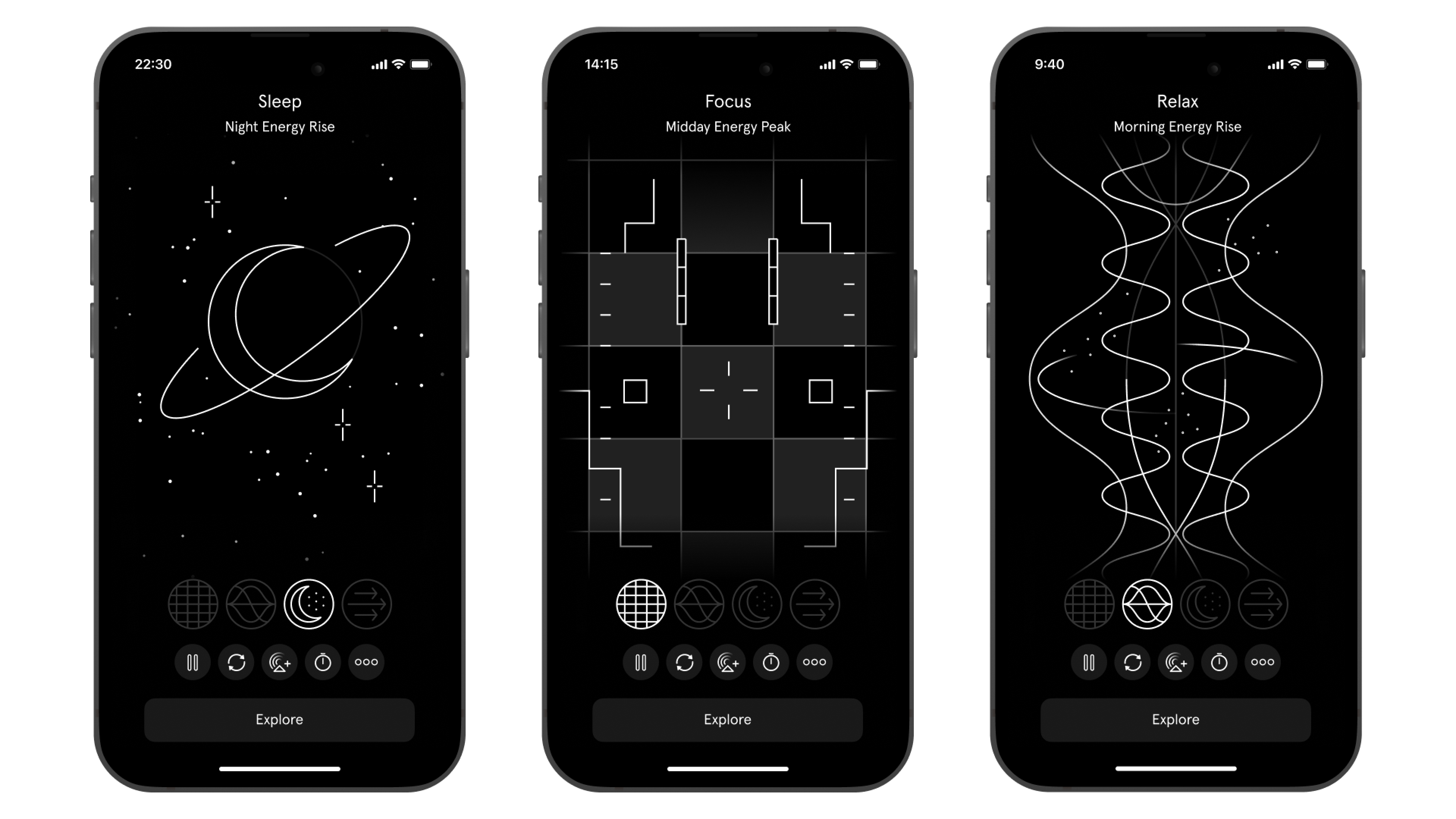
The core idea from the very beginning was: can we create a soundscape that is scientifically engineered to put you in a certain cognitive state? The three main cognitive states we defined early on were concentration, sleep, and relaxation.
As we started digging into the neuroscience of how sound affects your psyche and your emotional and physical state, we quickly realised it would have to be adaptive and personalised. That’s where the technology aspect of Endel comes from, it comes from neuroscience.
We didn’t start with, “Let’s build a generative ambient machine.” We started from observing a behaviour: people were using sound as a wellness tool, as a function.
I noticed that back in 2016 in my own behaviour. I realised I was playing specific music or records just to get into a certain cognitive state, not because I particularly liked them, but because they did something to me. I noticed other people doing the same thing. Suddenly there were all these “music for this, music for that” playlists and videos and mixes popping up.
But a lot of it was just someone throwing together a mix and saying, “You should sleep to this,” without any science behind it. So we started digging into the science. That’s when we realised it would have to be personalised and adaptive, and that we’d have to build this technology.
We’ve stayed true to that. It’s not designed for conscious listening. We don’t even call it music. We call it functional sound, or functional audio. It’s designed to put you in a certain cognitive state, and we’ve been diligently putting out content designed for that.
The way it’s expanded is that we realised it’s not enough to present people with a catalog of soundscapes and say, “Here are all the soundscapes; go figure out how to weave them into your life.” Especially for people who are not familiar with the concept, they don’t know what to do with it.
So now we’ve started designing features around the soundscapes to help people build routines, to introduce sound into their lives in a more guided way. That’s what’s changed.
“It’s not designed for conscious listening. We don’t even call it music. We call it functional sound, or functional audio.”
How did the neuroscience find its way to you? How did you actually approach that research?
Back in 2016–2017, when we started thinking about this, there wasn’t a lot of research around sound and sleep. And what we did find was pretty shallow: “Mozart relaxes you, AC/DC energises you,” that kind of thing. We were like, “Okay, but how?”
There are a few fundamental books, like This Is Your Brain on Music, that talk about this, but beyond that, hardly anyone was studying what happens in your brain on a second‑by‑second basis as you listen to certain sounds, and how specific scales and frequencies affect your psycho‑emotional and physical state.
We just read everything we could find. We found this book online called The Physics and Anatomy of Music by a Russian physicist. It was a very small print run. He was living somewhere in Europe at the time, but his wife was still at their house on the outskirts of Moscow, and she had some copies. I went there, bought all the remaining books, maybe ten, and brought them back to Berlin. We read the book and started talking to him.
He was actually the one who told us, “You can’t just create a recording. It needs to be adaptive.” That’s when we thought, “Oh, this is interesting. So we’re going to have to build this generative sound technology.”
The first time we met, many years ago, you showed me BUBL. The way I remember it, it was like a digital toy with interactive elements, where sound was a really important aspect. How is that connected to Endel?
There was a clear path. I remember when my first child was born and the first iPad came out. I was in LA at the time. I bought the iPad, unpacked it, opened the App Store. There were very few apps there, and one of the featured apps was Brian Eno’s Bloom.
I bought and downloaded it and was completely blown away by how elegant, simple, and mesmerising it was. Then I went back to Europe, gave the iPad to my daughter, and just watched her play.
It was fascinating. You just tap on the screen; there are no instructions, no defined gameplay. Whatever you do creates a soundscape that slowly fades away and makes space for something new. You can fiddle with settings to change the logic behind it. It’s essentially a generative soundscape that you create.
I thought, “This is cool.” My daughter is just tapping away, and I’m listening to Brian Eno. It looks great, something I’d love my child to interact with. Then I started looking at apps designed specifically for children and babies. There were very few that were really well‑designed, the kind of thing you’d want to show your kids.
That’s how the idea for BUBL was born. Our pitch was: interactive digital art for kids. These apps would be designed to teach children the correlation between colour, form, and sound.
One of the more successful apps was BUBL Draw, where you could literally draw with sound. You’d pick a colour, pick a theme, and depending on which form you drew, you’d create this Steve Reich‑like minimalist soundscape.
We had to build a lot of generative sound technology just to make that work. And when my co‑founders and I were designing BUBL (it’s the same group of co‑founders as Endel), we always said sound was going to be a very important aspect. In every app we released, sound was part of the gameplay. Your actions would generate a melody or a soundscape, and the sound would react in real time.
Dmitry Evgrafov, who is now the Chief Music Officer at Endel, was also the Chief Music Officer at BUBL. He did all the sound design and music production for those apps. So moving from BUBL to Endel was a very natural transition.
When you hear stories about how people use Endel in their lives, does any of it change how you think about your own work or habits?
Less personally, and more about human behaviour. Two things stand out.
First, people listen to Endel in all kinds of crazy situations. I’ve heard from multiple people that they gave birth while listening to Endel. We don’t have a soundscape specifically for that, but people say, “I played Endel for eight hours straight while giving birth.” That’s wild.
Second, the way people use Endel can be very different from how we designed it. Some people say, “I work a lot while listening to the Sleep or Relax soundscapes,” and I think, “What are you doing? It’s not designed for that!” But that’s what works for them.
Even though science says, for example, that to concentrate better you need a steady beat, and I firmly believe that, and the science supports it, many people just play white noise while they work, or they use our sleep soundscapes for that. It’s wild to me, but it’s real.
So you have this creator ego that says, “No, this is how you’re supposed to use it,” and then real life happens and people use it in all these interesting ways, often against what you envisioned. That’s life.
Is there something unexpected you’ve learned about yourself through this work?
Not so much about myself, but about letting go. You realise that once you put a product out into the world, you’re not in control anymore. You can’t force people to use it in the way you envisioned or think is “best.”
People are going to use it in weird and, from your perspective, incorrect ways, and you just have to be comfortable with that. Whatever you do, people will still do what they do.
What’s a common piece of advice or trope around wellness, productivity, or stress management where you disagree or have a different take?
There are a lot of conflicting views in wellness. One school says: listen to yourself, be attentive and gentle, follow your natural ebb and flow of energy. The other says: no, you need a rigid system and discipline, strong routines you stick to no matter what.
I’m definitely more in the first camp, even though I do believe routines help, and certain “ceremonies” around you can be useful.
In Russian there’s this expression that literally translates to “mittens made of hedgehog”. The idea is that you have to “hold” yourself very tightly, almost painfully, to keep yourself in check. There’s a lot of that mentality in wellness and fitness, and I don’t really believe in it.
At the same time, I do believe in sometimes pushing yourself, setting boundaries. You can’t be too “slimy,” for lack of a better word.
I also don’t think the two things are mutually exclusive: discipline and gentleness. I think you need to learn your own system and rhythm, and from there, things can click into place with more ease instead of force. But some people have very different personalities and might benefit more from a kind of ‘military’ approach.
Well, also, it’s the society we live in. Especially here in Germany, life follows a very rigid structure. The flow of life is extremely structured.
You don’t have kids, but I do, and that imposes even more structure because of the school holiday system. At the beginning of each year they publish the school holidays for each region, and every parent in Germany opens their laptop and books flights for the entire year.
You almost can’t afford to be spontaneous, especially with children and family. The most expensive thing in Germany is continuity. If you want to counter that rigidity, the only real alternative is to have a huge amount of money.
You recently launched Sources, an ambient label. Kind of a sister project to Endel perhaps. How did that come about, and what’s the vision?
It was a really interesting path to Sources.
Every day, hundreds of millions of people open DSPs like Spotify or Apple Music and search for “music for meditation,” “music for concentration,” “music for sleep.” The most consumed playlists on any DSP are functional playlists.
We thought, “We have to be there somehow. People need to learn about us.”
[Editor’s note: Throughout this section, you’ll see references to ‘DSPs’. This stands for Digital Service Provider, and is a common term in the music industry. In this interview, mentions of DSPs refer to music streaming services.]
That got us into this rabbit hole of what “wellness music” on streaming platforms actually is. We realised that many of the editorial playlists — those controlled by the DSPs — are filled with music created by ghost artists and ghost producers. It’s not necessarily AI-generated, despite that narrative. It’s made by people, but it follows a very specific formula that DSPs believe sleep music or concentration music is supposed to sound like.
We tried to get into that game. But being who we are, we said: we actually know from a neuroscientific perspective how sleep music is supposed to sound. So we’d hand them a sleep release from Endel, and it was almost completely incompatible with those editorial playlists, both creatively and sonically. The work we did with artists like James Blake and 6LACK was also too different stylistically. It just wouldn’t fit.
So we started looking for ways to build our own playlists, or at least show the DSPs there’s a different approach. That’s why we started publishing Endel’s music on streaming platforms. Then the broader narrative shifted: everyone became aware of the ghost artist problem, and there was a big pushback. There’s a big push for authenticity and for something real, that is created by real humans.
We also heard directly from wellness editors at DSPs that they’d prefer to playlist functional music made by real artists, not anonymous brands or ghostwriters. And because we have good relationships in the music industry, some editors asked if we could curate interesting artists and commission wellness music from them.
That’s how Sources was born. We said, “Let’s go and find amazing voices in the ambient space and co-create wellness music with them.” Music designed to live on those playlists, but still with the intentionality and authenticity of music created by real people.
And we would remove ourselves from the equation. We are not gonna hide the fact that we’re doing this, but we’re not gonna put Endel on each and every release. Actually, we would highlight the artist; we would make it about the artist, not about us.
We’ve released a few EPs already, and more music is coming out every month.
Have you ever received noteworthy advice about listening or is there advice about listening that you find yourself giving others?
It’s obviously not a secret that I’m a big fan of Brian Eno and all of his ideas about music that should be listened to at a barely audible level. Music that tends the environment, music that has its own life almost. I just find it fascinating and I’ve read all of Brian Eno’s books. I’ve been to his lectures, I’ve watched him speak about this.
I just find this idea extremely interesting. A composer creating a kind of framework and throwing components in, and then taking a kind of hands-off approach. And the listener being almost a co-creator of this piece. That has influenced everything that I’m doing from BUBL to, definitely, Endel.
In BUBL it was more of an active participation. Like, the children would draw, or pick up certain objects and they would contribute to the soundscape. In Endel, it’s more of a passive participation, just by listening to it and by providing your biometric data, you influence the output.
The idea is that music is a living, breathing organism that follows you everywhere. It’s almost like this external bodily function. I just find it extremely fascinating, and I’m endlessly inspired by that.