

We have entered an era of authorless media.
Six years ago, the world’s most popular music streaming service added 40,000 songs per day to its catalogue. Now, even smaller streamers are receiving more AI-generated tracks than that every day.
In 2019, I explored this topic in a column on the emergence of generative music (authorless) and how this could be contrasted by a countertrend of music that is less faceless (authorful).
The attention economy’s revenue models are optimised for personalisation:
Ad-supported platforms: personalised content makes it more likely you’ll keep listening or watching, thus allowing platforms to serve more ads to you. $$$.
Subscription platforms: the time spent watching or listening is a key metric to determine whether subscribers will stick around or cancel. If someone doesn’t use a service much, how do they justify the monthly payment?
While not every service has to chase these dynamics to their conclusion of extensive personalisation, the financial incentive to do so is ever-present.
The end state of personalisation
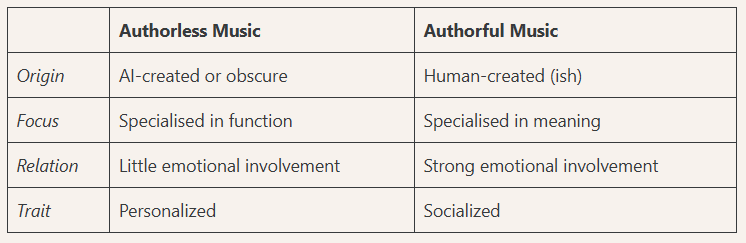
I believe authorless music is the logical conclusion of the attention economy’s drive towards personalisation. Here’s how I defined it in 2019:
Authorless Music:
primarily driven by AI or the listener is unable to tell whether the listed artist is a real person or an algorithm.
specifically targeted towards augmenting certain activities, moods, and environments.
due to its obscure origin, the listener has little emotional involvement with the creator.
in many cases it will be personalised to the listener’s music taste, environment, weather, mood, etc.
In contrast, one of the characteristics of ‘authorful’ music is “driven by human intent.”
And this has recently got me thinking…
What happens when the media we consume is no longer driven by human intent?
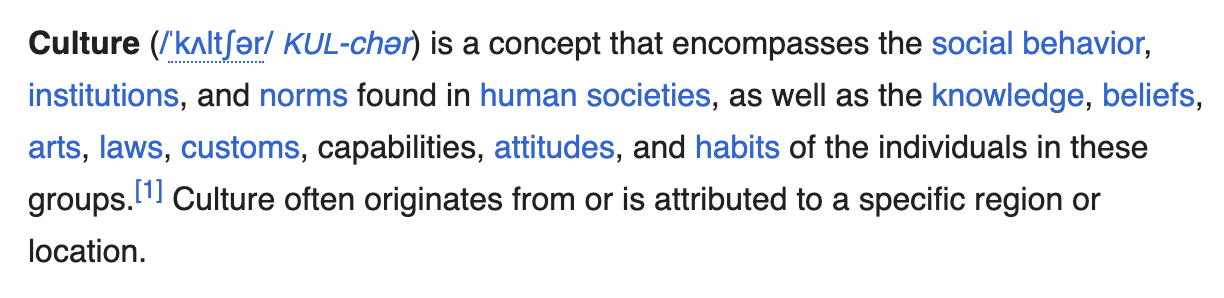
Culture is inherently social. But through pursuing never-ending personalisation, we’ve created a non-social, algorithmic form of human culture that has now entered hyperdrive through generative AI.
In the drive for more ad views, more time spent on services, we’ve ended up with advanced algorithms that can synthesise human cultural expression without further intentional input from people.
And those AI systems are far better than humans at reverse-engineering the recommendation algorithms that reward engagement with visibility. This guarantees abundant visibility for synthetic expression.
We have reached post-culture.
This is cause for reflection.
There are many questions to explore — each worth its own article.
Today, I want to highlight just one aspect:
When we think about cultural expression, we see the creator, the artist, the writer, the craftsperson. But that side of the equation is overvalued. Because the supposed ‘receiver’ is as much a participant in this culture, enabling the expression, as the person doing the expressing is.
The debate around whether AI can ‘truly’ be creative is philosophically interesting, but increasingly secondary. If the listener of AI-generated music can form a creative connection to this synthetic cultural expression, then the fact that there is no direct human intent involved in the creation of that specific music doesn’t matter, since it’s still enjoyed by a person, with intent.
The other side of the medal
As people spend more time with synthetic media — soon unable to distinguish between media created by human intent and that created by algorithms — they will experience the cost of this hyperoptimised personalised media environment: loneliness and disconnection.
Therefore, I believe in digital artisanship (authorful creations). About things that can be enjoyed in person, so you have a subconscious confirmation of its viscerality when you enjoy it digitally. I believe in communal experiences and social iteration, whether that’s dancing, jamming, remixing, or other forms of expression inspired by other people.
Our relationship with the internet’s entertainment culture will change, since ‘real’ and ‘synthetic’ will become indistinguishable unless there is some form of intervention by governments or platforms.
But in the age of post-culture, the need for culture won’t change.
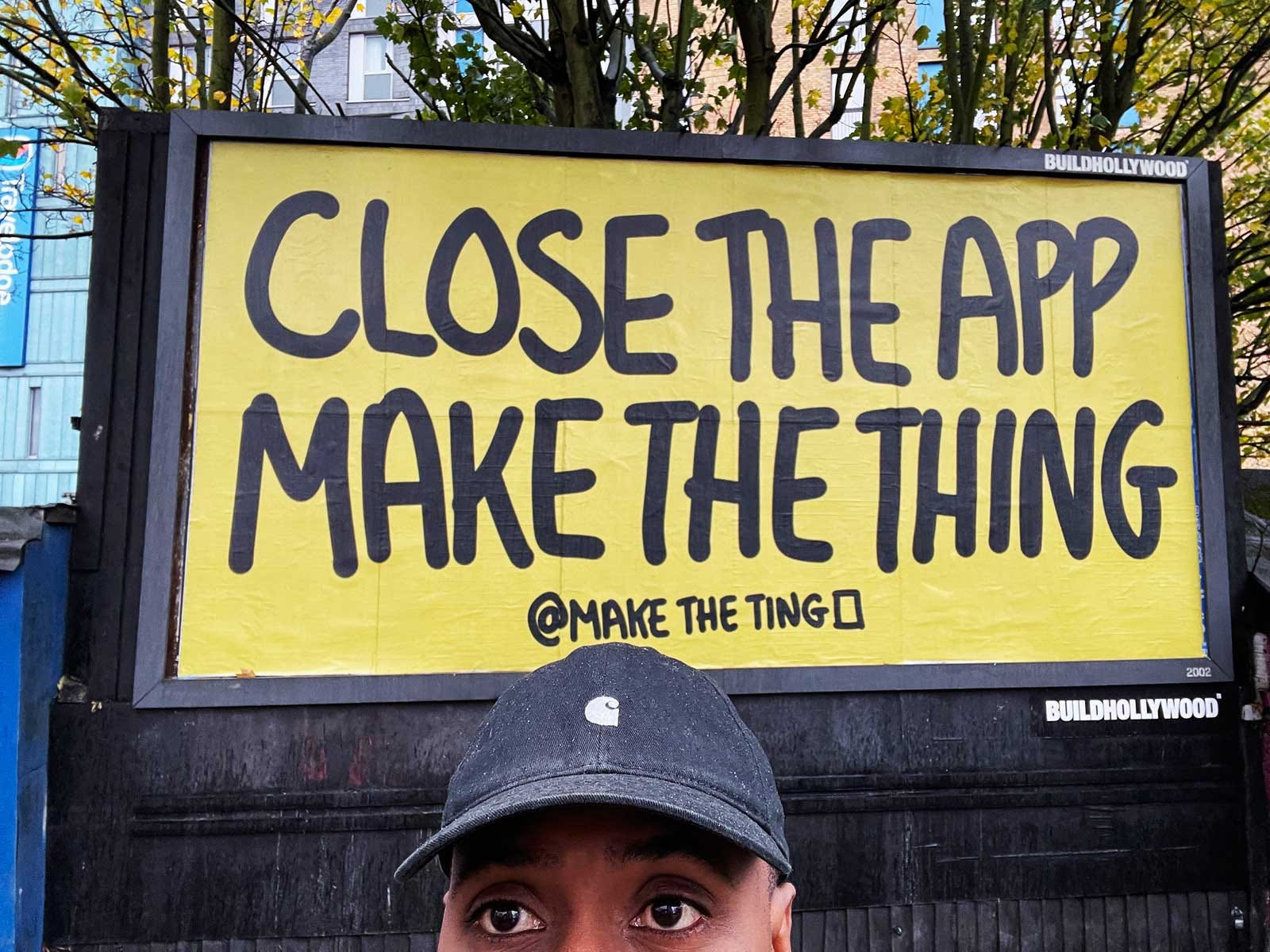
So spend some time with all the well-curated end-of-year recommendation lists. And, in the words of London-based grime music producer and DJ Elijah:
٩( ᐛ )۶ work with me ٩( ᐖ )۶
I’m looking for interesting missions to support starting early next year, either as a freelancer or in an embedded leadership capacity.
What I’m passionate about:
Culture, technology, music, mental and physical well-being, sustainability.
Where I add the most value:
Strategy, product leadership, team development, workshops & education, writing, concept development, innovation management.
In recent years, I’ve led teams at global music entertainment brand COLORS, headed up product at classical music streaming service IDAGIO, and taught at NYU’s Clive Davis Institute’s Berlin campus.
Learn more about me on my personal website or on LinkedIn where you can also find my contacts.