

Back when laptops were so heavy you could throw out your back lifting them… back when you’d have to make sure your laptop wouldn’t overheat by propping it up with books… back when closing your laptop meant all but going offline… there was a little browser plugin called StumbleUpon.

Hit the magic button in your browser, and it would take you to a random place on the internet. Over time, it would learn from your taste, taking you to ever better places. Before it was forgotten, it was huge. Bigger than any othe social network. The Verge:
“StumbleUpon drove more traffic in 2009 than any other social media site in the US, including Facebook, YouTube, Twitter, Digg, Reddit, and Pinterest.”
However, by the end of 2009, Facebook had eaten StumbleUpon’s lunch, and then some.
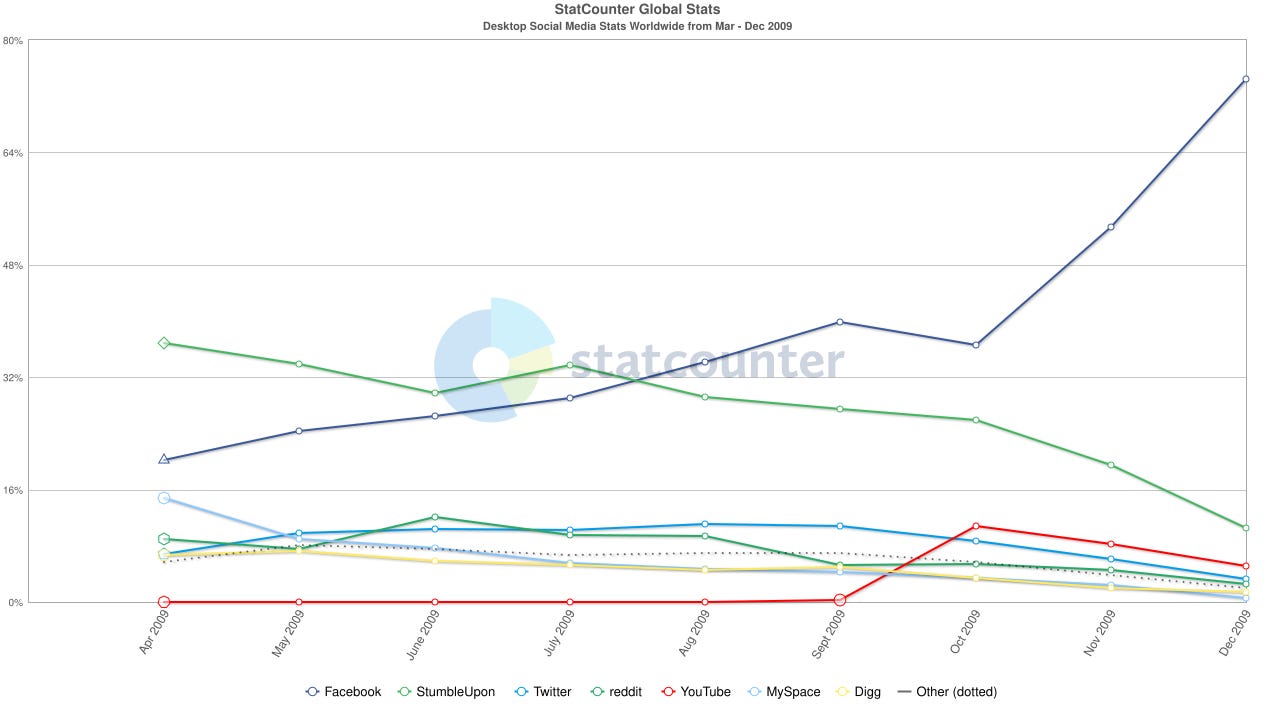
StumbleUpon was magical. One click could take you to a blog about the history of street art, another to Radioooo, a global ‘hit tune time machine’, and the next would teach you a cabbage recipe. Part of what I try to replicate in the Wholesome Corner section of the Friday editions of this newsletter is inspired by those years as a fervent StumbleUpon user.
In a way, it was like TikTok, but somehow more wholesome. Instead of a feed of content posted by users with profiles on a platform, it felt like being whisked across the cyberhighways of the world wide web to people’s carefully (though often clumsily) designed websites.
Over time StumbleUpon declined. Its co-founders moved on, one of whom founded Uber and re-acquired a majority stake in StumbleUpon in 2015. In 2018 it was merged with another of his content discovery apps, Mix.com. RIP StumbleUpon.
Could there be a new StumbleUpon?
Yes and no. On the one hand, we already have it through all the content recommendation systems underpinning the feeds of TikTok, Instagram’s Explore tab, YouTube, etc. But a StumbleUpon that flings you around the internet in the same way is impossible, because that internet doesn’t exist anymore. When people’s experience of content primarily happens through platforms, it promotes homogenization. This can take the form of ‘TikTok voice’ aka ‘uptalk’, the layout of posts through ‘safe zones’, or by the elimination of engagement-reducing phenomena, like the ‘millenial pause’.
Emma Nies explaining the millennial pause on TikTok:
“Have you guys ever noticed that when older people post? And by older, I mean like 35, 40s and on, they always start the video … wait 1-2-3 seconds to make sure it's filming, and then they smile and start talking. It's kind of funny and cute.”
But for anyone nostalgic or sad they could never experience StumbleUpon, there’s good news… The type of news that sent me into the history of rock and roll, learning to write graffiti, pixel art, and even the damn American Fuchsia Society while I should have been finishing this newsletter.


There are various attempts to recreate StumbleUpon in some shape or form. I’ve tried The Useless Web, Jumpstick, but my favourite is CloudHiker. The latter is a community-created random button that takes you to un(der)explored corners of the internet. It doesn’t have personalized algorithms and instead relies on community-curation with strict rules for what it allows and doesn’t allow into its database.
If you’ve touched grass and want some entertainment that is more engaging than watching the latest trash tv episode, take a break from social medias algorithms and give one of these StumbleUpon successors a try.
Maybe you’ll even end up with an extremely long doge.

(• ᵔ‿ᵔ •) Wholesome Corner
The Dwarf in China is a documentary that sees a children performer from Europe bring his show, and a beautifully designed barrel organ, to remote mountain villages in Yunnan, southwest China. The official website aptly describes it as “touching insight into the pursuit of magic by two men from the Netherlands in an effort to ward off the sterile harshness of modern reality.”
Neuroscientist TJ Power recommends physically separating yourself from your phone as a way to regulate screen time and dopamine levels. The most important thing: not making your phone screen the first thing you see in the morning and ‘creating momentum for your day’ before you go into quick dopamine land.
Atmos, a media org focused on climate & culture, recently launched a podcast series called The Nature Of which they describe as delving into “teachings from nature to navigate the experience of being human.” For example, the second episode discusses the nature of rhythm with Grammy-nominated musician Maggie Rogers.


