

We have all experienced times when music became more than entertainment. Some of us can name songs that changed our lives, and most of us have experienced music helping us get things done. Relaxing piano for focus and study playlists, I’m looking at you.
But music can have a more medical purpose, too.
Last year, I saw Kate Berkita speak about music therapy for people living with Parkinson’s disease on a panel at the Music Frontiers conference in Berlin. Her deeply personal connection to the disease prompted her to draw on her backgrounds in music production and product management to co-found Parkinsonic, an app that delivers music therapy for Parkinson’s patients at home.
Throughout the interview, I learned about:
Why acceptance is one of the hardest parts of living with Parkinson’s
How music increases dopamine, and why that matters for Parkinson’s patients
The difference between music therapy and music as entertainment
How biomarkers like tremor and voice can be translated into personalised music therapy
What’s missing from the current Parkinson’s care pathway, especially at home
Published in collaboration with MUSIC x — a newsletter about innovation and music’s future, which I founded 10 years ago. Now stewarded by Maarten Walraven.

What was the moment you felt: “I need to do something about Parkinson’s”?
The story behind Parkinsonic started more than six years ago, when my mother was diagnosed with Parkinson’s disease. At that time, I didn’t know anything about Parkinson’s disease at all.
What we first noticed was tremor and shaking in her hands. It turned out she was already in the second stage of the disease. We somehow missed the first stage and the first symptoms, and she herself also didn’t understand what was happening.
About four and a half years ago, I moved to Germany, and for a long time, I only saw her via WhatsApp video calls. I saw how fast the disease was progressing. I could see her hands shaking more, her facial expression changing. I thought, whoa, this is something really hard to see, even on video, because I saw how the hands were shaking, how her face changed.
But I didn’t see her environment, and I didn’t see how she’s actually living, because people with Parkinson’s disease, in later stages, start to have very slow movement. She had problems with standing up, dressing, and many other things related to that.
Clinics and doctors cannot see those symptoms and can only get a snapshot of the current state when patients visit. But what’s going on at home, they cannot see. So I started thinking I should do something.
I started reading research papers and PhD theses, and watching talks and presentations. That’s when I discovered a project called MedRhythms. They use a device worn on the feet that generates musical rhythm from the way a person walks. People with Parkinson’s often lose their internal sense of rhythm, and hearing an external rhythm can help them move more easily.
That project inspired me. I thought: I have my technical background, I have my music background. I studied at a music school in Berlin and work as a music producer and artist there. So I started thinking: wow, AI‑generated music can really help to produce something personalised for people with Parkinson’s.
And that’s how Parkinsonic was born.
What are some of the early signs of Parkinson’s that people often miss?
From what I’ve learned through research, one of the very early signs can be depression. People feel low, withdraw from social contact and communicate less with others.
Another early symptom I didn’t know about before is loss of smell. People gradually lose their sense of smell, but it’s not always obvious or connected to Parkinson’s in their minds.
At the same time, Parkinson’s manifests very differently from person to person, and we lack knowledge about the different stages of the disease.
“Right now, the most effective approach is, of course, drug therapy, and usually, doctors don’t really believe in non-pharmaceutical approaches.”
From being close to your mother’s experience, what do you think people most misunderstand about living with Parkinson’s day to day?
In my case, I realised that my mother didn’t accept the disease for a very long time, until I started to speak with her very openly: “Mom, you’ve changed. Look, something is happening. You should accept that, and you should trust the doctors, and at least use the proper medication.”
Many people with Parkinson’s are not ready to accept they have it. And this is very hard to see, to be honest.
I don’t know how it is for other people, but I also had customer interviews with people who have Parkinson’s disease for building Parkinsonic’s first solution. Somehow, all of them were very positive, and they’re trying to do a lot of things that can help: exercising, speaking with other people, visiting groups, doing something personal like Instagram videos, blogs, and sharing stories. It’s very good.
But not everyone is like that. Usually, people start to close themselves off and not show anything. They stay alone. With this disease, it’s very hard.
It sounds like you’re building Parkinsonic very much with those people in mind: people who are at home, often alone with the disease. Can you walk me through the journey of building the app?
My first idea was to create a small chatbot where people could record a short video and say how they are feeling, and receive an audio file with music that can help reduce symptoms, or music that is exactly how they want to feel. That was the first idea.
After bringing medical advisors and neuro‑experts onto the team, we added five different tasks that measure changes in tremor, voice and facial expression. We then translate these parameters into AI music therapy.
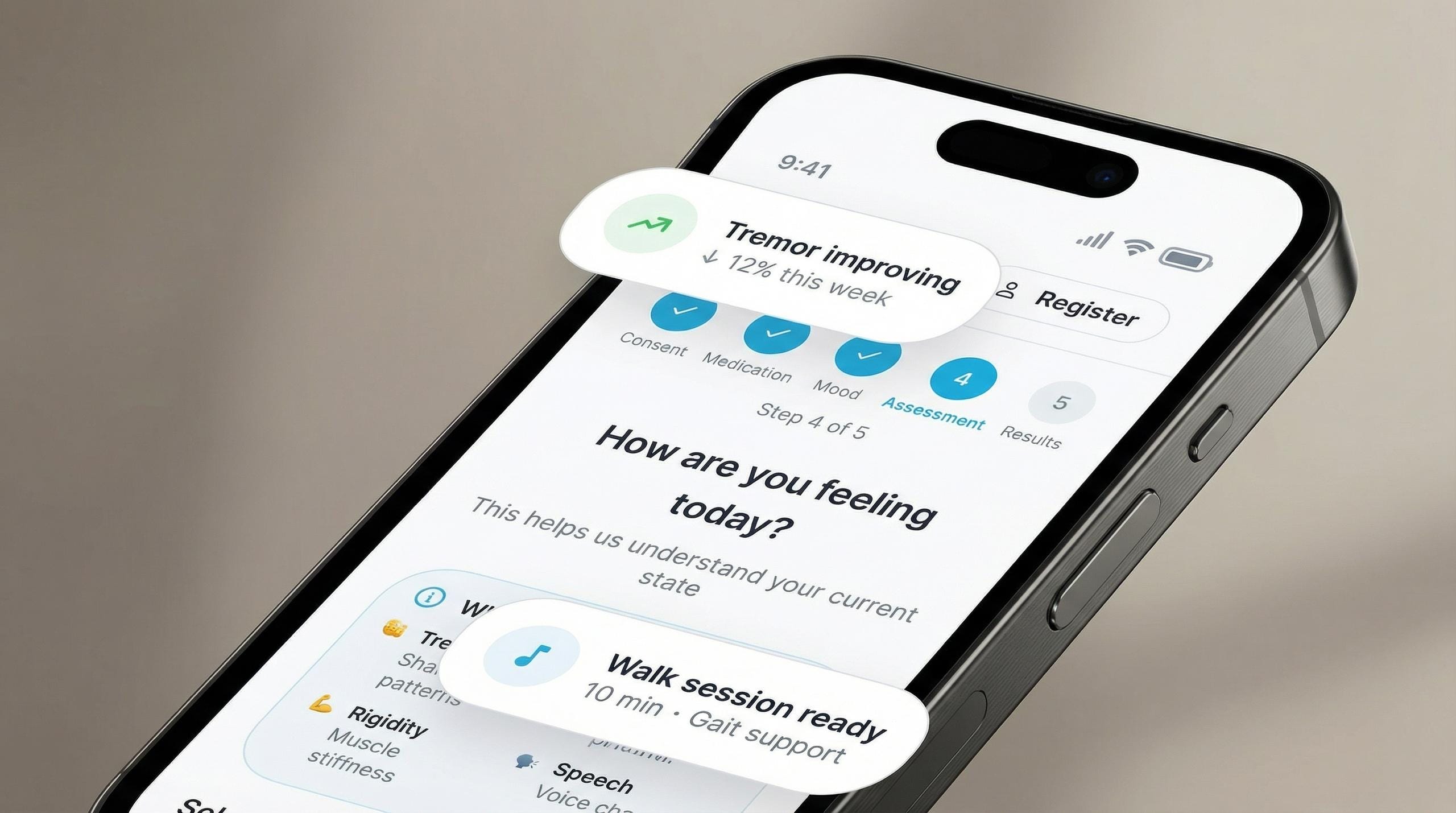
So today Parkinsonic is a web app. People register, complete a short “check‑in”, do the five tasks, and then have music as therapy.
“There’s also a lot of evidence that rhythmic stimulation can help people to move.”
What kind of tasks are those?
They’re video tasks. For example, a basic neuromotor check‑in, where the person is asked to smile, say certain words, and do simple facial and hand movements.
For tremor, they do standard exercises they’d also do when visiting a neurologist.
We use the tasks to estimate the person’s current stage. If they do daily check‑ins or even just weekly, we can see the progression. All of this is then shown in a kind of dashboard.
How do music and rhythm come into the picture?
Music can increase dopamine. For example, when you hear your favourite tracks, you get goosebumps and feel some energy. That means the dopamine in your brain is increasing.
Usually, people with Parkinson’s have less dopamine. This is exactly how the disease is often described: less dopamine, less energy, less motivation.
My idea was to take the biomarkers we measure, like tremor, voice and facial expression, and translate them into musical parameters: tempo, rhythm, frequency, and atmosphere. On top of that, we ask the user about their preferences and goals.
After the check‑in and five tasks, people can choose their favourite instrument, genre and the goal of the music therapy. For example: sleeping, calming down, walking and being more active, or focusing on work. It depends on the goal, and we create a special sound for it.
Earlier, you mentioned rhythm, almost like a metronome for movement. Can you explain that part?
In physiotherapy and occupational therapy, a metronome is often used for certain tasks. For example, putting on a jacket or doing other daily routine tasks. With rhythm, patients move faster and more easily.
There’s also a lot of evidence that rhythmic stimulation can help people to move.1 We use those parameters for various goals.
People can be very specific about their music taste. How do you handle someone who, say, really hates electronic music?
Music therapy is not ‘normal music as entertainment’. Music therapy has a specific goal, and music therapists who work in clinics create music in the moment, on the spot. When they see the person, they understand what they need and create some sound.
It’s not always going to be ‘full’ in the usual musical sense, because it’s a prescription of therapy, like a pill. It’s not always pleasant, but it’s necessary to listen and connect with the brain.
But we are trying to understand what people like and give them the opportunity to choose the genre and the instruments.
If you could redesign part of the Parkinson’s care pathway as it exists today, what would you change?
In my case, my mother lives in Russia, and not every city has a Parkinsonologist. This is a relatively new profession in the field. Usually when people have Parkinson’s disease, they go to a neurologist, but there are also Parkinsonologists who focus only on Parkinson’s disease.
I think it requires a bit more education in general, both about the disease and about the therapy options. Right now, the most effective approach is, of course, drug therapy, and usually, doctors don’t really believe in non-pharmaceutical approaches.
I would love for there to be more opportunities for people with Parkinson’s disease that can help them, and for doctors to prescribe these therapies. Because right now, standard care is physiotherapy, occupational therapy, maybe music therapy, only in clinics where people have music classes, but not at home.
At home, they have almost nothing, and they don’t have any motivation to do something. That’s why we are creating Parkinsonic, where people can use it at home.2 They have a check-in with professional standards that measures Parkinson’s disease metrics, then they see results, and have something at least at home. This is the idea.
Parkinson’s affects people differently. If you’re considering new therapies, discuss them with a healthcare professional. You can learn more about Parkinson’s symptoms and treatment options from the Parkinson’s Foundation or Parkinson’s UK.
Meta-analysis of 18 randomized controlled trials found that Rhythmic Auditory Stimulation (RAS) improves motor function, including UPDRS III scores, gait speed, stride length and mobility in Parkinson’s disease. https://www.frontiersin.org/articles/10.3389/fneur.2022.940419/full
Studies investigating remote/app-based Rhythmic Auditory Stimulation (RAS) and its impact on real-world walking activity in Parkinson’s disease:
https://pmc.ncbi.nlm.nih.gov/articles/PMC10657706/
https://pmc.ncbi.nlm.nih.gov/articles/PMC12041193/
Happy 10 years Bas!