

Last week I had the pleasure to lead a panel at the MUSIC FRONTIERS conference in Hamburg, Germany.
The topic was ‘Music as medicine’ and our intention was to shine a spotlight on some of the wonderful, often tech-enabled, health interventions being done through music.
Music is used to manage symptoms of dementia, Parkinson’s, but many of us also use it to find focus or manage stress through personal playlists or communal experiences.
Joining me on the panel were:
Jessie Dymond of Overflow, who works at the intersection of music, experience design, and community infrastructure.
Goran Lazarevic of the University of Music and Theatre Hamburg, who is involved with a project called Healing Soundscapes, which tries to make hospital waiting areas less unpleasant through musical interventions.
Saskia Wheeler, a neuroaesthetics researcher whose work focuses on translating neuroscience into real-world sensory experiences.
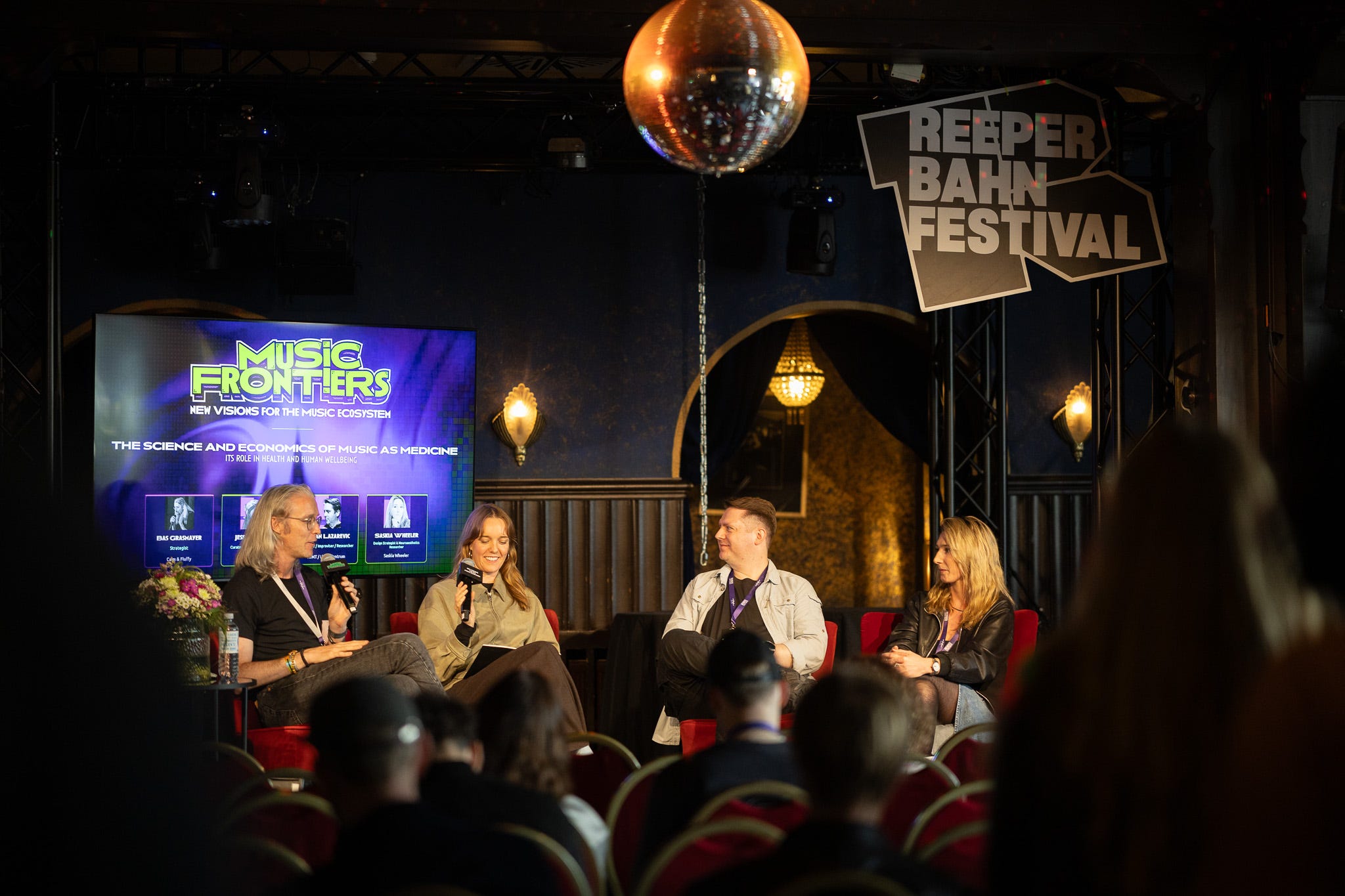
We spoke about measuring impact, advocacy, and funding. What struck me is that although many of the benefits are clear, funding is often precarious at best. Which led me to the question: what if in 2035 the research and use of music in health and wellness interventions has changed dramatically for the better, what does that future look like? And what steps did we take to get there?
I’m looking forward to exploring that question in more detail in the future.
A second takeaway from my time in Hamburg, this time in the context of the Reeperbahn Festival which attracts 5k+ delegates from across the music industry, is about AI.
I was invited to a roundtable organised by the German association for independent music (VUT) to discuss algorithmic sameness with about a dozen experts: people from music tech, studio owners, trend watchers, artists, people from labels & publishers.
While there is a lot of doom & gloom about how “AI is coming for us”, this conversation didn’t seem to strand there. It almost felt optimistic.
Yes, the attention economy, platform economics, algorithms, and now AI have pushed music towards ‘sameness’ in order to perform better in the algorithm. But we’re also seeing that performing well in the algorithm does not mean you can fill rooms with fans or build a sustainable career in music.
AI is great at gaming systems faster than we can, but what it’s not great at is the authentic connection people are craving, and it’s not good at musical innovation either. It’s missing context for that: the fears, anxieties, hopes, and dreams of people; whether the direction of an art form creates an escape or confrontation of those, or something different altogether.
Is done better than perfect?
Generative AI generalizes. That means: it’s good at creating summaries and capturing certain vibes or sounds, but it struggles with cultural originality. So AI as a lazy tool is good for “done is better than perfect.”
Previously, that was good. Publish consistently and you’ll build an audience. But now anyone can publish consistently. And they do. Loads of it. All affected by algorithmic sameness: LinkedIn is full of bland summaries of “here’s what happened and this is why it matters for [insert profession]”.
Scroll through Suno’s feed of music and no matter how original people’s topics for their songs, you’ll soon tire of hearing the same predictable ‘catchiness’ and songs that behave exactly as you would expect them to within their genre.
It’s a cultural flattening. Good enough is not good anymore. It’s bad.
But that is good news.
Because authenticity is something people actively desire perhaps more than ever. The same goes for original thinking and for being able to contextualise in a way that is only possible when you have been ‘in the room’, an active participant of the culture, with an emotional experience.
These are things AI won’t be able to capture until they are data points that can be generalized from. And when they’re data points, the culture will already have moved on.
Just like how a band is likely no longer at the cutting edge of cultural innovation by the time big publications write about them. What has worked for them, to get where they are, is different for people starting today. The context has shifted.
And so the context will have shifted whenever AI catches on, and as soon as AI catches on, the context shifts again as everyone turns the niche thing that worked into a mainstream phenomenon.
Good is safe. Safe is boring.
Original thought and authenticity will be rewarded.
On the weekends, you can find me cycling around Berlin, followed by groups of 15-20 Dutch or Belgian tourists. I guide them through the city’s layered history of wars, division, cultures and sub-cultures, hedonism and repression.
Besides public speaking, it’s the one thing I do that I’m sure won’t be replaced by AI.
Why?
People want to hear stories from locals. They want to see a city through someone else’s eyes. They want authenticity. And maybe they want some interaction, or to meet fellow travellers, and be in a group.
Sure, people use ChatGPT, social media, Wikipedia, or travel guides to learn about a city or self-guide themselves, so do I. And for some, that’s enough: they would have defaulted to paper travel guides in the past. But the part that is irreplaceable is the personal connection; a history shaped by people told by a person who lives in a context shaped by the stories he’s sharing.
It’s the same for art.
If you’re in Lisbon next month, catch me for the closing keynote of MIL Lisboa on October 9th. It’s titled, Hopecore: How to matter when music is infinite.
ᕱᕱ For your ears ᕱᕱ
Actress has a new album out. I’m curious to hear everyone’s opinions. I always enjoy the dreamy, lo-fi, dancefloor-adjacent sounds Actress explores and this is no exception. It’s getting great reviews, but perhaps none as glowing as Paul Clarke’s in DJ Mag:
“The closing ‘Sheets’ is an absolute tour-de-force, a mesmerising 16 minutes of Rainy Miller’s treated vocals, ambient pads and subtle rhythms that shift from drum & bass to techno, making it one of the best things Actress has ever done, and one of the most astonishing pieces of electronic music we’ve heard in years.”
⏯️ Bandcamp